Kiteworks and CPS 230 Operational Resilience: IT Capability and Embedded Controls
Prudential Standard CPS 230 Operational Risk Management has been in force since 1 July 2025, with the service-provider contract transition period ended 1 July 2026. It requires all APRA-regulated entities across Australia’s banking, insurance, life insurance, private health insurance, and superannuation sectors to manage operational risks, maintain critical operations within tolerance levels, and govern service provider arrangements.
Kiteworks strengthens operational resilience through a hardened virtual appliance with enterprise-grade encryption, intrusion detection, and file integrity monitoring, plus high availability clustering that sustains critical operations. The platform enforces ABAC runtime risk policies and captures comprehensive audit logs fed to SIEMs in real time. Organizations can meet APRA’s 72-hour, 24-hour, and 20-business-day notification windows through immediate log timeliness and continuous monitoring dashboards.
Sustaining Sound IT Capability and Embedded Internal Controls
CPS 230 requires APRA-regulated entities to maintain sound information technology capability supporting critical operations while managing technology risks, and to design, implement and embed internal controls that mitigate operational risks and meet compliance obligations. Entities struggle to secure infrastructure against evolving threats, monitor system health continuously, patch third-party vulnerabilities promptly, and enforce consistent access controls across every data exchange channel. Fragmented tooling and manual processes leave gaps that undermine both resilience and demonstrable control effectiveness. CPS 230 has been in force since 1 July 2025, with the transition period for existing service-provider contracts ending 1 July 2026.
Hardened Appliance and Runtime Policy Enforcement
Kiteworks delivers sound IT capability through the virtual appliance with built-in hardening and defense in depth, providing enterprise-grade encryption, an embedded firewall and web application firewall, multiple types of intrusion detection, and file integrity monitoring. SNMP Health Monitoring tracks CPU, memory, disk, and queue metrics to support continuous system health visibility. For internal controls, ABAC runtime policies aligned to the NIST CSF Framework, Authorization combining RBAC and ABAC, and data policy templates embed repeatable, dynamic governance across every data exchange channel.


Operationalizing Broad Control and Service Provider Obligations
CPS 230 imposes wide-ranging control duties spanning disruption prevention, operational risk oversight, information systems monitoring, control testing, business continuity, and material service provider management. Entities must prevent disruption to critical operations, sustain tolerance levels, test severe but plausible scenarios including service provider failures, and govern third-party data handling with sovereignty constraints. Coordinating high availability, continuity testing, and service provider risk management across disparate systems creates enormous operational complexity that manual approaches cannot reliably deliver or evidence.
Continuity Resilience and Service Provider Governance
Kiteworks operationalizes CPS 230’s control obligations through MFT Server high availability without single points of failure and scale-out clustering that distributes workflow execution across additional nodes while maintaining centralized management and monitoring, to sustain tolerance levels and test severe but plausible scenarios. ABAC runtime policies, compliance summary reports, and security analytics support risk oversight. For service providers, direct Kiteworks-to-Kiteworks vault-to-vault integration, third-party integrations, connection usage monitoring, and data policy engine data sovereignty, geography, and geofencing controls route and store data only in an assigned country.


Meeting Strict Tracking and APRA Notification Windows
CPS 230 sets demanding notification duties: 72 hours after a material operational risk incident, 24 hours after a critical operation disruption outside tolerance, and 20 business days after entering or materially changing a critical service agreement. Entities must record, monitor, and report on controls, incidents, continuity, and service providers with durable evidence. Systems that delay log entries, lack real-time alerting, or cannot produce on-demand records leave entities unable to detect disruptions promptly or meet APRA’s tight reporting deadlines with credible documentation.
Real-Time Logging Inside APRA\\\’s Reporting Windows
Kiteworks enables the 72-hour incident window reporting through log timeliness, where entries append immediately and feed external syslogs and Splunk servers in real time, plus comprehensive audit logs with SIEM feeds and threat intelligence notifications. For the 24-hour disruption notification, immediate log timeliness and SNMP health monitoring supply disruption evidence. Comprehensive audit logs clean, normalize, standardize, and aggregate log data into a single stream, while the compliance report – audit log, connection usage monitoring, and admin reporting produce durable records exportable via CSV for Board, senior management, and APRA accountability.
Frequently Asked Questions
CPS 230 requires entities to maintain sound information technology capability supporting critical operations while managing technology risks, and to design, implement and embed internal controls that mitigate operational risks and meet compliance obligations. It has been in force since 1 July 2025, with the transition period for existing service-provider contracts ending 1 July 2026.
Kiteworks delivers sound IT capability through the virtual appliance with built-in hardening and defense in depth, providing enterprise-grade encryption, an embedded firewall and web application firewall, multiple types of intrusion detection, and file integrity monitoring, along with ABAC runtime policies aligned to the NIST CSF Framework, RBAC and ABAC authorization, and data policy templates.
Kiteworks operationalizes CPS 230’s control obligations through MFT Server high availability without single points of failure and scale-out clustering, ABAC runtime policies, compliance summary reports, security analytics, direct Kiteworks-to-Kiteworks vault-to-vault integration, and data sovereignty controls including geography and geofencing to route and store data only in assigned countries.
Kiteworks enables the 72-hour incident and 24-hour disruption notification windows through immediate log timeliness feeding external syslogs and Splunk servers in real time, comprehensive audit logs with SIEM feeds and threat intelligence notifications, SNMP health monitoring, and compliance reports that produce durable, exportable CSV records for Board, senior management, and APRA accountability.
Featured Resources
Data Sovereignty Is Architecture, Not A Contract Clause 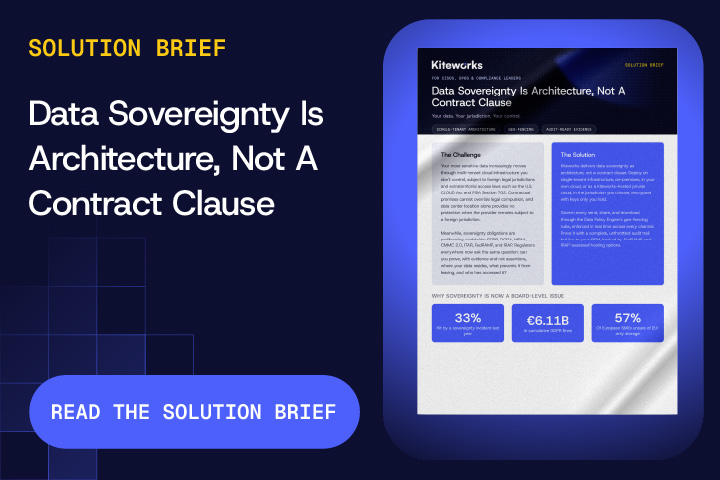
Data Sovereignty Is Architecture, Not A Contract Clause
Kiteworks Supports Australia’s Prudential Standard CPS 230 Operational Risk Management 
Kiteworks Supports Australia’s Prudential Standard CPS 230 Operational Risk Management
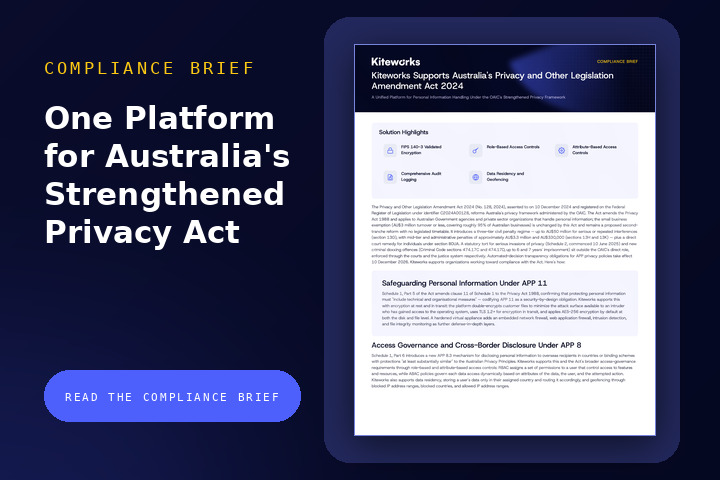
Kiteworks Supports Australia’s Privacy and Other Legislation Amendment Act 2024