
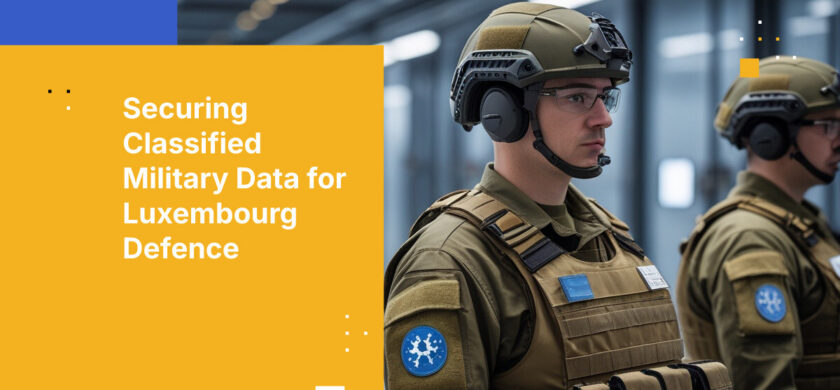
Luxembourg Defence Contractors: Protecting Sensitive Military Information
Luxembourg’s defence sector operates within one of Europe’s most sophisticated security environments, where military contractors handle classified information that directly impacts national security and NATO operations. These organisations face unprecedented challenges in protecting sensitive data whilst maintaining operational efficiency across complex supply chains and international partnerships.
Defence contractors must navigate stringent security requirements that extend far beyond traditional IT governance. Military information requires protection at every stage of its lifecycle, from initial data classification through collaborative development and secure distribution to authorised personnel across multiple jurisdictions.
This article examines how Luxembourg defence contractors can establish comprehensive security frameworks that protect classified military information whilst enabling the collaboration essential for modern defence operations.
Executive Summary
Luxembourg defence contractors operate in a threat environment where state-sponsored actors actively target military information, whilst regulatory compliance frameworks demand rigorous security controls that protect national interests. These organisations must implement security architectures that secure classified data throughout complex collaboration workflows, maintain strict access controls across international partnerships, and provide comprehensive audit capabilities that satisfy both military standards and civilian oversight requirements.
The challenge extends beyond protecting data at rest to securing information as it moves between contractors, government agencies, and international allies. Defence contractors require security frameworks that enforce classification levels, track data lineage across organisational boundaries, and provide real-time visibility into potential security incidents without compromising operational efficiency.
Key Takeaways
- Specialized Data Classification. Military contractors require classification frameworks beyond standard enterprise security to protect technical specs, plans, and personnel data.
- Cross-Border Governance Challenges. NATO collaborations demand consistent security standards across multiple jurisdictions and regulatory environments.
- Supply Chain Risk Extension. Protection requirements must apply to all subcontractors with equivalent controls and continuous audit readiness.
- Real-Time Threat Detection. Continuous monitoring and tamper-proof audit trails are essential to counter APTs and meet defence compliance standards.
Understanding Military Information Classification Requirements
Defence contractors handle multiple categories of sensitive information, each requiring specific protection measures that align with national security protocols. Technical specifications for military equipment, operational deployment plans, personnel security clearances, and intelligence assessments all demand different security controls and access restrictions.
Classification levels determine how information can be stored, transmitted, and shared across organisational boundaries. Defence contractors must implement systems that automatically enforce these classifications whilst enabling authorised personnel to access information needed for mission-critical activities.
Implementing Dynamic Access Controls for Classified Information
Military information requires access controls that adapt based on security clearance levels, operational contexts, and time-sensitive mission requirements. Static permissions cannot address the dynamic nature of defence operations, where access needs change rapidly based on deployment schedules and threat assessments.
Effective access control frameworks evaluate multiple factors simultaneously, including user security clearances, device security posture, network location, and information sensitivity. These systems must make real-time decisions about access whilst maintaining detailed audit trails that document every interaction with classified information.
Defence contractors benefit from implementing zero trust architecture that verifies every access request regardless of previous authentication status or network location. This approach ensures that compromised credentials or insider threats cannot escalate into broader security incidents that compromise military operations.
Managing Cross-Border Data Sharing with Allied Nations
Luxembourg defence contractors frequently collaborate with partners across NATO member states, requiring secure file sharing mechanisms that respect each nation’s sovereignty whilst enabling effective joint operations. These collaborations involve sharing technical specifications, operational intelligence, and strategic planning documents across multiple jurisdictions with varying regulatory requirements.
Cross-border military collaboration requires security frameworks that can enforce the most restrictive classification requirements whilst maintaining operational efficiency. Contractors must ensure that information shared with international partners receives appropriate protection throughout its lifecycle, regardless of which organisation currently has custody of the data.
Successful international collaboration depends on establishing mutual recognition agreements for security standards, implementing consistent classification schemes, and maintaining continuous visibility into how shared information is being used and protected by partner organisations.
Building Comprehensive Supply Chain Security
Modern defence contracts involve extensive supply chains where subcontractors, technology partners, and speciality vendors all handle aspects of classified information. Each organisation in this chain represents a potential security vulnerability that adversaries might exploit to gain access to military secrets.
Supply chain risk management requires extending protection requirements to every organisation that touches classified information, regardless of their size or involvement scope. Prime contractors must ensure that subcontractors implement equivalent security controls and can demonstrate continuous compliance with military security standards.
Establishing Security Standards for Subcontractors
Effective supply chain risk management begins with clearly defined security requirements that subcontractors must meet before gaining access to classified information. These requirements should address technical security controls, personnel vetting procedures, physical security measures, and incident response capabilities.
Subcontractor security assessments must evaluate both technical capabilities and organisational maturity. Small speciality contractors may have excellent technical expertise but lack the security infrastructure necessary to protect classified information appropriately. Prime contractors need frameworks for identifying these gaps and either providing additional security support or limiting subcontractor access to non-classified information.
Ongoing monitoring ensures that subcontractors maintain their security posture throughout the contract lifecycle. Regular assessments, security audits, and continuous monitoring of data access patterns help identify potential security degradation before it leads to information compromise.
Monitoring Data Flow Across Contractor Networks
Military projects often involve information flowing between multiple contractors, government agencies, and international partners simultaneously. Understanding where classified information resides at any given time becomes essential for maintaining security and ensuring appropriate access controls remain in effect.
Data flow monitoring requires visibility into how information moves between organisations, what transformations it undergoes during processing, and which personnel have accessed it throughout its lifecycle. This visibility enables security teams to identify unusual access patterns that might indicate insider threats or external compromise attempts.
Effective monitoring systems track not just data access but also data derivatives, such as reports generated from classified source material or technical documents that incorporate classified specifications. These derivatives often contain sensitive information requiring protection equivalent to the original classified material.
Implementing Real-Time Threat Detection for Military Information
State-sponsored actors actively target defence contractors using sophisticated techniques that traditional security tools may not detect. These APTs often conduct long-term reconnaissance operations, gradually escalating their access to more sensitive information over extended periods.
Real-time threat detection for military information requires understanding normal access patterns for classified data and identifying deviations that might indicate malicious activity. This includes monitoring for unusual data access volumes, access from unexpected locations or devices, and attempts to access information outside an individual’s normal scope of responsibility.
Detecting Advanced Persistent Threats in Defence Networks
APTs targeting defence contractors often use legitimate credentials and authorised access channels, making them difficult to distinguish from normal business activities. These threats typically focus on high-value military information and use patient, methodical approaches to avoid detection whilst gathering intelligence.
Detection systems must analyse behavioural patterns rather than relying solely on signature-based approaches. Anomaly detection algorithms can identify subtle changes in access patterns, data movement volumes, or user behaviour that might indicate ongoing compromise attempts.
Effective threat detection integrates multiple data sources, including network traffic analysis, endpoint behaviour monitoring, and data access logging, to build comprehensive pictures of potential threats. Machine learning algorithms help identify patterns that human analysts might miss whilst reducing false positive alerts.
Coordinating Incident Response Across Military Supply Chains
Security incidents affecting military information often span multiple organisations within defence supply chains. Effective incident response requires coordination mechanisms that enable rapid information sharing whilst maintaining appropriate security classifications and operational security requirements.
Incident response coordination must balance the need for rapid information sharing with requirements to protect ongoing investigations and prevent adversaries from understanding defensive capabilities. Pre-established communication channels and response protocols help ensure that incident information reaches appropriate stakeholders without compromising operational security.
Ensuring Audit Readiness for Military Security Reviews
Defence contractors face regular security audits that evaluate their ability to protect classified information appropriately. Compliance is governed by strict frameworks, including Luxembourg’s national data protection legislation enforced by the Commission Nationale pour la Protection des Données (CNPD), EU mandates such as the NIS 2 Directive for essential defence supply chain entities, and NATO STANAG security standards governing classified information handling.
Audit readiness requires maintaining continuous documentation of security activities, access controls, and incident response actions. Auditors need to verify that security controls function as designed and that organisations can demonstrate consistent adherence to military security standards.
Maintaining Tamper-Proof Documentation for Security Clearances
Security clearance reviews require comprehensive documentation that demonstrates an organisation’s consistent adherence to military security standards. This documentation must be tamper-proof and provide clear evidence of security control effectiveness over extended periods.
Tamper-proof audit trails document not just access events but also the security context surrounding each access, including device security posture, network security status, and any security incidents that occurred during the timeframe. This comprehensive documentation helps auditors understand the complete security environment rather than just isolated access events.
Automated documentation systems reduce the administrative burden whilst ensuring consistent documentation standards. These systems can generate compliance reports that map security activities to specific military security requirements, making audit processes more efficient for both contractors and government reviewers.
Demonstrating Continuous Compliance Across Contract Lifecycles
Military contracts often span multiple years, during which security requirements may evolve and organisational circumstances may change. Contractors must demonstrate continuous compliance throughout these extended periods, showing that security controls remain effective regardless of organisational or operational changes.
Continuous compliance monitoring tracks security control effectiveness over time, identifying trends that might indicate degrading security posture before they lead to non-compliance findings. Proactive monitoring enables contractors to address potential issues before they affect their ability to handle classified information.
Conclusion
Safeguarding classified military data in Luxembourg’s defence sector requires moving beyond conventional perimeter security toward zero trust data protection architectures. Contractors must safeguard technical specifications, intelligence, and operational plans across international supply chains while adhering strictly to CNPD regulatory guidelines, NIS 2 Directive requirements, and NATO STANAG security standards. By combining automated content classification, real-time threat detection, dynamic access controls, and tamper-proof audit trails, Luxembourg defence contractors can ensure mission-critical security and audit readiness without impeding necessary collaborative workflows with NATO allies.
Kiteworks Private Data Network
The Kiteworks Private Data Network—FIPS 140-3 validated, enforcing TLS 1.3 in transit, and FedRAMP High-ready—provides Luxembourg defence contractors with purpose-built capabilities for securing classified information whilst enabling the collaboration essential for modern military operations.
The platform creates secure enclaves for military information that enforce classification-based access controls, provide tamper-proof audit trails, and maintain continuous visibility into data access patterns across complex supply chains. This architecture enables defence contractors to share classified information securely with authorised partners whilst maintaining the stringent security controls required by military security standards.
Defence contractors using Kiteworks can implement zero trust architecture and data-aware security policies that automatically adapt to changing classification requirements, operational contexts, and threat environments. The platform’s security integrations ensure that security events and audit data flow seamlessly into existing SIEM, SOAR, and ITSM workflows, enabling comprehensive security operations without disrupting established processes.
Luxembourg defence contractors seeking to protect classified military information across complex supply chains can schedule a custom demo of the Kiteworks Private Data Network.
Frequently Asked Questions
Military contractors must handle technical specifications, operational plans, and personnel data with specialised protection frameworks that extend beyond standard enterprise security, enforcing classification levels from initial creation through secure distribution.
Contractors must ensure consistent security standards across multiple regulatory environments and jurisdictions while respecting each nation’s sovereignty, often enforcing the most restrictive classification requirements during joint operations.
Every subcontractor and partner handling classified information must demonstrate equivalent security capabilities and audit readiness, as each represents a potential vulnerability that adversaries could exploit to access military secrets.
Defence contractors must maintain tamper-proof documentation meeting CNPD regulations, the NIS 2 Directive, and NATO STANAG standards to demonstrate continuous adherence during security clearance reviews and audits.