
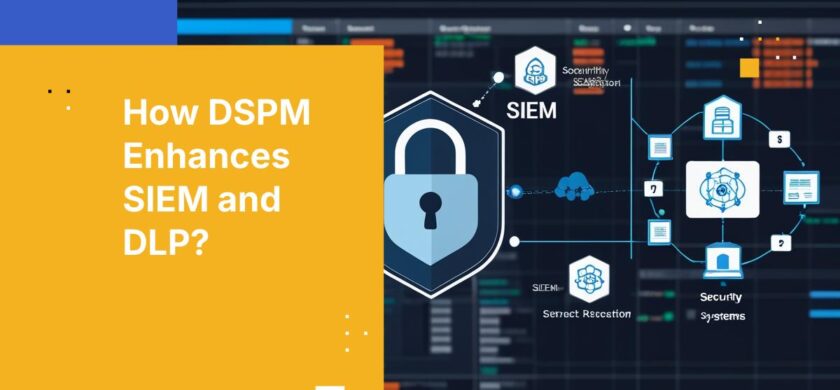
Which DSPM Platforms Integrate with SIEM and DLP? A Guide to Unified Data Protection
Your security tools shouldn’t operate as isolated islands. Yet for most organizations, that’s exactly what happens—DSPM discovers sensitive data in one console, SIEM correlates security events in another, and DLP enforces policies somewhere else entirely. The result? Blind spots, delayed responses, and breaches that slip through the gaps.
This guide answers two questions security leaders ask when building a unified data security stack: which DSPM platforms actually integrate with SIEM and DLP tools, and how do you connect them effectively? You’ll find specific vendor options, integration patterns, evaluation criteria, and practical guidance for making these tools work together to close security gaps.
Executive Summary
Main Idea: Data Security Posture Management (DSPM) solutions gain significant operational value when integrated with SIEM and DLP tools, creating a continuous feedback loop where data discovery informs threat detection and policy enforcement. Leading DSPM platforms now offer native integrations with major SIEM solutions like Splunk, Microsoft Sentinel, and Chronicle, as well as DLP tools from Microsoft Purview, Symantec, and Forcepoint.
Why You Should Care: Organizations using disconnected security tools face longer breach detection times, inconsistent policy enforcement, and compliance gaps that regulators increasingly scrutinize. With the average data breach costing $4.44 million globally in 2025—and U.S. organizations facing $10.22 million per incident—the cost of operating security tools in silos far exceeds the investment required for proper integration.
Key Takeaways
- DSPM-SIEM integration enriches threat detection with data sensitivity context. When your SIEM understands which assets contain sensitive data, it can prioritize alerts accordingly. Suspicious access on a database containing customer PII warrants faster escalation than the same pattern on a marketing repository.
- DSPM-DLP integration improves classification accuracy and reduces false positives. Traditional DLP relies on regex-based pattern matching, which generates significant noise. DSPM’s AI-powered data classification feeds accurate sensitivity labels to DLP engines, enabling precise enforcement without overwhelming security teams.
- Leading DSPM vendors prioritize integration breadth as a competitive differentiator. Platforms like Varonis, Cyera, and Symmetry Systems DataGuard offer extensive integrations spanning multiple SIEM, SOAR, and ticketing systems. Evaluate integration depth—not just connector availability—when selecting a solution.
- Microsoft Purview DSPM exemplifies the trend toward native ecosystem integration. Microsoft’s approach integrates DSPM directly with Sentinel through its data lake, enabling third-party signals from partners like Varonis, BigID, and Cyera to flow into a unified posture view.
- Integration gaps create enforcement gaps—where most breaches actually occur. DSPM excels at discovering data at rest, but protection breaks down when data moves externally. Organizations need solutions that extend DSPM intelligence to data-in-motion channels like email, secure file sharing, and APIs.
What Is DSPM and Why Does Integration Matter?
Data Security Posture Management emerged in Gartner’s 2022 Hype Cycle for Data Security, addressing a fundamental challenge: organizations couldn’t protect data they didn’t know existed. DSPM platforms continuously discover and classify sensitive data across cloud, SaaS, and on-premises environments, providing the visibility foundation other security tools require.
But visibility alone doesn’t prevent breaches. DSPM tells you where sensitive data lives and what risks surround it. Translating that intelligence into protective action requires integration with tools that detect threats (SIEM), enforce policies (DLP), and orchestrate responses (SOAR).
Consider what happens when these tools operate independently. Your DSPM discovers an AWS S3 bucket containing unencrypted customer records with overly permissive access. Your SIEM logs unusual download activity from that bucket—but without sensitivity context, the alert gets the same priority as hundreds of others. Your DLP might catch someone emailing a file from that bucket, but only if it matches a predefined pattern.
Now consider the integrated scenario. DSPM classification feeds into your SIEM, triggering an immediate high-priority alert because the system knows that bucket contains sensitive PII. That same classification informs DLP policies, ensuring consistent enforcement based on actual sensitivity rather than keyword matching. This closed-loop approach transforms fragmented tools into a cohesive defense system.
Which DSPM Platforms Integrate with SIEM Tools?
SIEM platforms aggregate and correlate security events from across your environment. When enriched with DSPM insights, they make smarter decisions about which events deserve attention.
How Do DSPM-SIEM Integrations Work?
Most DSPM-SIEM integrations work through three approaches. API-based data sharing exposes classification and risk data through REST APIs that SIEM solutions query for real-time enrichment. Log forwarding sends discovery findings and risk alerts to SIEM platforms as structured events for correlation and historical analysis. Native connectors provide pre-configured integrations requiring minimal setup—Microsoft’s Purview DSPM and Sentinel integration exemplifies this model.
Which DSPM Vendors Offer Strong SIEM Integration?
Symmetry Systems DataGuard integrates with Chronicle SIEM, LogRhythm, Securonix, Splunk, and SumoLogic, forwarding data risk findings and classification events for correlation with other security telemetry.
Varonis Data Security Platform provides integrations with Splunk and other major SIEM platforms, sending data access anomalies, permission changes, and classification events for centralized monitoring.
Cyera Data Security Platform integrates with Splunk and extends reach through Tines for security orchestration.
Microsoft Purview DSPM integrates directly with Sentinel through a shared data lake, enabling third-party signals from partners including Varonis, BigID, Cyera, and OneTrust to create a unified posture view.
What Does SIEM Gain from DSPM Integration?
Context-aware alert prioritization becomes possible because SIEM understands which data assets matter most. Compliance correlation improves because DSPM provides continuous visibility into where regulated data resides. Incident investigation accelerates because analysts immediately see what sensitive data might be affected, enabling faster scoping and more accurate impact assessments during security events.
Which DSPM Platforms Integrate with DLP Tools?
DLP has protected organizations from data loss for decades, but traditional approaches struggle with cloud complexity and classification accuracy. DSPM integration addresses both challenges by bringing modern, AI-powered classification to established enforcement mechanisms.
Traditional DLP tools rely on regex patterns and keyword matching, generating significant false positives while missing sensitive content that doesn’t match predefined patterns. DSPM solutions use machine learning and contextual analysis to classify data more accurately, understanding not just what data looks like but what it actually represents. When DSPM classification feeds into DLP policies, enforcement becomes more precise and security teams spend less time chasing false alarms.
How Do DSPM-DLP Integrations Work?
Label-based integration involves DSPM applying sensitivity labels (often through Microsoft Information Protection) that DLP tools use to enforce policies. When DSPM classifies a document as “Highly Confidential,” DLP automatically applies appropriate controls without re-analyzing content.
Policy enrichment involves DSPM feeding risk context into DLP decision-making. If DSPM identifies a data store with overly permissive access, DLP can apply stricter policies to content from that location.
Which DSPM Vendors Offer Strong DLP Integration?
Proofpoint DSPM integrates with Proofpoint DLP and Microsoft Information Protection, creating unified classification-to-enforcement workflows.
Zscaler DSPM uses a single DLP engine delivering consistent protection across web, SaaS, public cloud, private applications, email, and endpoints.
Microsoft Purview combines DSPM and DLP within the same platform, enabling seamless workflows where sensitivity labels automatically trigger DLP policies across Microsoft 365 and third-party environments.
How to Evaluate DSPM Integration Capabilities
Not all integrations are equal. When evaluating DSPM solutions, consider factors beyond connector availability to ensure the integration delivers real operational value.
Integration depth matters—surface-level integrations might only forward basic alerts, while deeper integrations share classification data, risk scores, and remediation status. Ask vendors to demonstrate exactly what data flows between systems. Bidirectional communication enables DSPM to receive feedback from SIEM and DLP, refining risk assessments based on detected threats and violations. Real-time updates through APIs and webhooks beat scheduled batch processes for security operations where minutes matter. Ecosystem breadth protects against vendor lock-in if your organization migrates platforms later.
Ask vendors pointed questions: What specific data elements flow to SIEM platforms? How does DLP integration handle classification conflicts? What’s the latency between DSPM discovery and that data appearing in integrated tools? Can we customize what flows through the integration, or is it all-or-nothing?
What Are the Risks of Operating Without Integration?
Organizations maintaining disconnected tools face measurable risks beyond operational inefficiency that compound over time.
Detection delays occur because SIEM treats all data access equally without DSPM context. Analysts waste time on low-risk events while high-risk anomalies wait in queues. IBM research shows organizations take an average of 241 days to identify and contain breaches—a number that increases when tools can’t share intelligence effectively.
Enforcement gaps emerge because DLP without DSPM context relies on static rules that can’t adapt to evolving data landscapes. Shadow data—stores created outside sanctioned processes—remains completely unprotected because DLP doesn’t know it exists. This blind spot grows larger as organizations expand cloud adoption.
Compliance exposure grows as regulatory frameworks increasingly expect integrated data compliance. Showing auditors three disconnected tools telling different stories about sensitive data creates audit friction and potential findings. Regulators want to see cohesive controls, not fragmented point solutions.
Financial impact compounds quickly. The 2025 Cost of a Data Breach report found organizations using AI and automation in security saved $2.2 million compared to those that didn’t. Integration enables that automation—you can’t automate responses to threats you can’t correlate across tools.
How Kiteworks Extends DSPM Protection Beyond Your Perimeter
Even perfectly integrated DSPM, SIEM, and DLP solutions share a common limitation: they primarily protect data at rest. But breaches increasingly occur when data moves—when someone emails a classified document externally or uploads sensitive content to a third-party tool. Traditional DSPM visibility ends at organizational boundaries, creating a gap where much of the actual risk resides.
Kiteworks addresses this gap by operationalizing DSPM intelligence at the moment of greatest risk—when data moves externally. The Private Data Network ingests classification labels from DSPM solutions through Microsoft Information Protection or direct API integration, automatically applying controls when users share classified content through any channel.
MIP Label Ingestion enables Kiteworks to automatically enforce policies on documents labeled by DSPM tools via Microsoft Purview or integrated APIs. When someone shares a “Confidential” document, the system applies time-limited access, download restrictions, and advanced encryption methods without manual intervention.
Role- and Attribute-Based Access Controls define policies based on data attributes (including sensitivity labels), user attributes (role, location), and specific actions. RBAC and ABAC enable nuanced enforcement—view-only access for some recipients, full editing for others—based on context rather than rigid rules.
SafeEDIT Possessionless Editing enables secure collaboration without file downloads. External users view and edit documents streamed to their browsers, eliminating the risk of data leaving organizational control while still enabling productive collaboration.
Unified Audit Logging provides real-time visibility into every access, share, and transfer—including external exchanges. This extends DSPM’s chain of custody beyond organizational boundaries, supporting compliance with GDPR, HIPAA, CMMC 2.0, and ISO 27001.
The gap between knowing where sensitive data lives and controlling what happens when it moves is where breaches occur. Kiteworks bridges this gap by ensuring sensitivity context follows data wherever it travels, transforming DSPM investments from visibility tools into complete zero trust data protection strategies.
To learn more about extending your DSPM investment with automated policy enforcement for data in motion, schedule a custom demo today.
Frequently Asked Questions
Several DSPM platforms integrate well with Splunk for financial services SOC environments. Symmetry Systems DataGuard, Varonis, and Cyera all offer Splunk integrations that forward classification data, risk alerts, and access anomalies for correlation with other security telemetry. Varonis has particularly deep Splunk integration given its longer market presence. When evaluating, ask vendors what data elements flow to Splunk and whether integration supports bidirectional communication.
Microsoft Purview DSPM integrates natively with Sentinel through a shared data lake architecture, enabling seamless data flow between DSPM discovery and SIEM monitoring. For organizations using Microsoft 365 DLP, Purview provides unified classification through sensitivity labels that automatically trigger DLP policies across Exchange, SharePoint, OneDrive, and Teams. Microsoft has expanded DSPM to ingest third-party signals from Varonis, BigID, and Cyera, extending visibility beyond Microsoft environments.
DSPM integration can significantly improve legacy DLP accuracy by providing more precise classification than regex-based approaches. When DSPM applies sensitivity labels through frameworks like Microsoft Information Protection, existing DLP tools enforce policies based on those labels rather than re-classifying through pattern matching. This reduces false positives and catches sensitive data legacy DLP misses, extending your existing investment’s useful life while improving protection.
For healthcare organizations managing PHI across multi-cloud environments, look for DSPM solutions with healthcare-specific classification that integrate with DLP tools understanding HIPAA requirements. Microsoft Purview, Proofpoint DSPM, and Zscaler offer strong healthcare compliance support. Ensure classification-to-enforcement consistency—PHI classified by DSPM should automatically trigger appropriate DLP controls regardless of cloud environment. Consider how integration handles data in motion, since PHI shared with business associates represents significant HIPAA exposure.
Traditional DSPM-SIEM-DLP integrations primarily protect data at rest within organizational boundaries. To prevent unauthorized exposure when data moves externally—including to AI tools like ChatGPT—you need solutions extending DSPM intelligence to data-in-motion channels. Kiteworks addresses this by ingesting DSPM classification labels and automatically enforcing policies when classified content is shared through secure email, secure MFT, or collaboration tools, including blocking uploads to unauthorized AI services based on classification.
Additional Resources
- Brief Kiteworks + Data Security Posture Management (DSPM)
- Blog Post DSPM vs Traditional Data Security: Closing Critical Data Protection Gaps
- Blog Post DSPM ROI Calculator: Industry-Specific Cost Benefits
- Blog Post Why DSPM Falls Short and How Risk Leaders Can Mitigate Security Gaps
- Blog Post Essential Strategies for Protecting DSPM‑Classified Confidential Data in 2026