
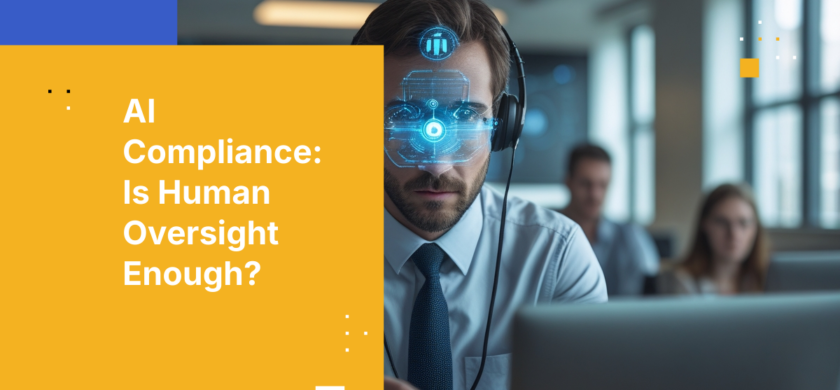
Human in the Loop: What It Means for AI Compliance and When It’s Required
“Human in the loop” is one of the most frequently cited — and least precisely defined — concepts in AI data governance. Organizations invoke it to assure boards that AI decisions are being reviewed. Regulators require it as a condition for deploying high-risk AI. Vendors advertise it as a feature. And in practice, it is often implemented in ways that satisfy the label without satisfying the requirement.
The compliance gap this creates is significant. A human review process that is too shallow, too slow, or too disconnected from the underlying AI decision chain does not constitute meaningful oversight — and regulators are beginning to say so explicitly. The question is not whether humans are involved in your AI workflows. It is whether that involvement is genuine, documented, and defensible when an auditor examines it.
Executive Summary
Main idea: Human in the loop is not a single defined standard — it is a spectrum of oversight mechanisms ranging from full human review of every AI output to minimal intervention rights. What constitutes compliant oversight depends on the regulation, the risk level of the AI use case, and whether the mechanism is genuinely capable of influencing outcomes or is merely procedural.
Why you should care: GDPR Article 22, the EU AI Act, HIPAA clinical decision support guidance, and financial services model risk frameworks all impose human oversight requirements — with different thresholds and different evidentiary standards. Organizations that implement nominal oversight without documentation to prove it is meaningful face the same regulatory exposure as organizations with no oversight at all.
Key Takeaways
- Human in the loop is a spectrum — requirements range from a right to request human review (GDPR Article 22) to mandatory human authorization before AI action (EU AI Act high-risk systems) to continuous monitoring of AI outputs (financial services model risk).
- Nominal oversight is not compliant oversight — a reviewer who lacks the information, authority, or time to genuinely influence an AI decision does not satisfy meaningful human review requirements.
- The delegation chain is the evidentiary foundation of human oversight — every AI agent action must be attributable to a human authorizer, preserved in a tamper-evident audit record.
- Human oversight requirements apply to AI agents as well as AI-assisted decisions — autonomous workflows accessing regulated data without human authorization trigger the same obligations as AI recommendations presented to human reviewers.
- Genuine oversight requires data-layer enforcement — an audit trail documenting who authorized what, when, and under what policy distinguishes real oversight from compliance theater.
What “Human in the Loop” Actually Means
The phrase describes the degree to which human judgment is incorporated into an AI system’s decision or action process. For compliance purposes, three distinct levels matter — and which level a regulation requires determines what your organization must implement and document.
Human authorization (strongest form). No AI action occurs without explicit human approval. The human reviews the proposed action, has genuine authority to modify or reject it, and their decision is logged before execution. This is what EU AI Act Article 14 requires for high-risk AI systems — and what Kiteworks’ delegation chain implements for AI agent data access: every agent action is authorized by a human decision-maker whose identity and approval are preserved in the audit record.
Human review (intermediate form). AI outputs are presented to a human who reviews them before they are acted upon, but the reviewer may lack full visibility into the AI’s reasoning, or may be reviewing at a volume that makes careful attention impossible. This satisfies the letter of some requirements — including the right to obtain human review under GDPR Article 22 — but regulators are increasingly scrutinizing whether review at this level is genuinely meaningful.
Human oversight (weakest compliant form). Humans monitor AI outputs at a population level, with the ability to intervene when patterns of error are detected, but individual decisions are not reviewed before they take effect. This is the minimum acceptable standard for lower-risk AI and the model used in financial services model risk management. It is not sufficient for high-risk AI where individual decisions have significant effects on specific individuals.
The compliance failure most organizations make is implementing human oversight when human authorization is required, or nominal review when genuine review is required. Understanding which level applies to each use case is the foundational question of human-in-the-loop compliance.
What Data Compliance Standards Matter?
When Human Oversight Is Legally Required
The regulatory landscape for human oversight of AI is converging across major frameworks — but the specific requirements, triggers, and evidentiary standards differ enough that each framework must be assessed independently for each AI deployment.
GDPR Article 22. Individuals have the right not to be subject to decisions based solely on automated processing that produce legal or similarly significant effects. Where such processing occurs, organizations must provide a lawful basis, meaningful information about the logic involved, and the ability to obtain human review of the decision, express their view, and contest the outcome. This is a right-to-request standard — human review must be available and genuine, but it need not occur before every decision. A DPIA is required before deploying any system that triggers Article 22.
EU AI Act — High-Risk AI Systems. For AI systems classified as high-risk under Annex III — covering credit scoring, employment screening, healthcare, education, law enforcement, critical infrastructure, and border control — human oversight is mandatory and must be built into system architecture before deployment. Article 14 requires that high-risk AI systems allow oversight by individuals who understand the system’s limitations, can interrupt or override its operation, and can decide not to use it in a specific situation. This is an architectural requirement for genuine human control, not just a procedural right. Designated oversight individuals must be trained and their authority documented.
HIPAA and Clinical Decision Support. HIPAA compliance does not contain an explicit human-in-the-loop mandate for AI, but FDA guidance distinguishes between software that informs a clinician’s independent judgment (lower regulatory burden) and software that replaces clinical judgment (medical device classification). The practical standard for HIPAA-covered clinical AI: final decisions affecting patient care must remain with licensed clinicians. The HIPAA Security Rule adds that AI systems accessing PHI must produce audit trails sufficient to reconstruct who made which decision and when.
Financial Services Model Risk (SR 11-7). The Federal Reserve and OCC’s SR 11-7 model risk guidance — the de facto standard for AI in U.S. banking — requires ongoing human monitoring of model outputs, with defined validation, outcome review, and override documentation processes. FINRA has issued parallel guidance for algorithmic trading and customer communication systems. The financial services standard is accountability at the model level — systematic monitoring, exception reporting, and a documented escalation process — not individual decision review.
| Framework | Oversight Level Required | Trigger | What “Meaningful” Requires |
|---|---|---|---|
| GDPR Article 22 | Human review on request | Automated decisions with legal or significant effects on individuals | Reviewer must have genuine authority to modify outcome; review cannot be purely notional |
| EU AI Act Article 14 | Human authorization (architectural requirement) | High-risk AI system categories (Annex III) | Specific identified humans with training, authority, and ability to interrupt or override must be designated before deployment |
| HIPAA / FDA CDS Guidance | Clinician judgment preserved | Clinical decision support AI affecting patient care | Licensed clinician must apply independent judgment; AI cannot supplant clinical decision-making without medical device classification |
| SR 11-7 (Financial Services) | Human monitoring and override | Any model influencing financial decisions | Model validation, outcome monitoring, exception reporting, and override documentation with defined escalation processes |
What Makes Human Oversight Genuine vs. Theatrical
The most consequential distinction in human-in-the-loop compliance is between oversight that is genuine — capable of actually influencing AI outcomes — and oversight that is theatrical — nominally present but structurally incapable of doing so. Four conditions must be met for oversight to be genuine.
The reviewer must have sufficient information. A reviewer who receives an AI recommendation without visibility into the underlying data, the confidence of the output, or the factors that drove it cannot exercise genuine judgment. EU AI Act Article 13 requires that high-risk AI systems provide “sufficient transparency” to enable human oversight — which means the reviewer must see enough to evaluate, not just to approve.
The reviewer must have authority to act. A reviewer who can flag disagreement but whose flag has no effect — because the AI decision has already taken effect, or because override authority rests elsewhere — is not exercising oversight. Genuine oversight requires that the reviewer can modify, reject, or delay the AI’s action, and that their decision is what actually determines the outcome.
Review volume must be consistent with genuine attention. One of the most common failures is review queues that exceed any individual’s capacity for careful attention. Regulators examining human-in-the-loop compliance increasingly ask about review volume, time-per-review, and override rates. A near-zero override rate signals that reviews are not independent of the AI’s output.
Oversight must be documented. Human oversight that is not documented cannot be proven. The audit standard is a tamper-evident record of who reviewed what, when, under what information, and what decision they made. This is the delegation chain Kiteworks enforces for every AI agent data interaction — the human authorizer is identified, their authorization is linked to the specific action, and the complete record is preserved in the audit trail feeding your SIEM.
Human Oversight for AI Agents — a Special Case
The human-in-the-loop conversation in most organizations focuses on AI-assisted human decisions — a model that recommends a loan approval, flags fraud, or suggests a diagnosis. The human reviews the recommendation and decides. This is the model GDPR Article 22 and most early AI governance discussions assumed.
Autonomous AI agents operating across enterprise data systems are a different challenge. An agent that accesses files, sends communications, or executes transactions is not making a recommendation — it is taking action directly. The governance standard that satisfies regulatory requirements for agentic AI is the delegation chain: every AI agent action must be traceable to a human decision-maker who authorized the workflow, with that authorization preserved in a tamper-evident record. The human is accountable for the authorized scope — not for reviewing each individual action — but that accountability must be evidenced at the interaction level, not just the workflow level.
This is a meaningful and enforceable standard. It requires that every AI agent is authenticated with an identity linked to a human authorizer; that the scope of what the agent can access is defined by ABAC policy enforced at the data layer before any action occurs; that every data interaction is logged in a tamper-evident audit trail preserving the delegation chain; and that the human authorizer can be identified and held accountable for every agent action within the authorized scope. This is human in the loop not as a review queue, but as governance architecture — accountability embedded in how the AI operates, not added on as a procedural step afterward.
Kiteworks Compliant AI: The Delegation Chain That Makes Human Oversight Defensible
The hardest part of human-in-the-loop compliance for AI agents is not getting humans involved — it is making that involvement traceable, attributed, and audit-ready for every agent interaction with sensitive data. Most organizations implement oversight at the workflow level, where a human approves a process before it runs. What auditors ask for is oversight at the interaction level — who authorized this specific action, on this specific data, at this specific time, and under what policy.
Kiteworks compliant AI enforces the delegation chain at the data layer inside the Private Data Network:
- Every AI agent is authenticated and linked to a human authorizer before any data access occurs; ABAC policy governs what the agent can do with that data at the operation level;
- FIPS 140-3 Level 1 validated encryption protects all data in transit and at rest;
- A tamper-evident audit trail captures every interaction — who authorized it, what data was accessed, what action was taken, and when.
- The data policy engine ensures that no agent action occurs outside the authorized scope, regardless of what the model was instructed to do.
When a regulator asks how your organization maintains human accountability for AI agent actions, the answer is a structured evidence package — not a process description.
Contact us to see how Kiteworks implements the delegation chain for your AI deployments.
Frequently Asked Questions
No — GDPR Article 22 requires that individuals have the right to obtain human review of automated decisions that produce legal or similarly significant effects, not that every decision be reviewed before it takes effect. However, the right must be genuine: the review process must be available, the reviewer must have authority to modify the outcome, and the organization must be able to demonstrate that the review is meaningful rather than notional. Where Article 22 applies, organizations must also provide meaningful information about the logic of the automated decision, allow the individual to express their point of view, and document how human review requests are processed and resolved.
The EU AI Act Article 14 requires that high-risk AI systems — covering credit scoring, employment, healthcare, education, law enforcement, critical infrastructure, and border control — be designed so that human oversight can be effectively exercised before the system is placed on the market or put into service. This means designating specific individuals with the competence and authority to understand the AI system’s outputs, monitor its operation, interrupt or override it when necessary, and decide not to use it in a given situation. It is an architectural and organizational requirement — not just a procedural right — and it must be evidenced by training records, oversight logs, and documented override processes. A DPIA should assess whether the proposed oversight mechanism meets this standard before deployment.
Autonomous AI agents that access data, execute transactions, or take consequential actions without presenting outputs to a human for review require a different oversight model than AI recommendation systems. The governance standard that satisfies regulatory requirements for agentic AI is the delegation chain: every agent action must be attributable to a human authorizer who defined the scope of what the agent is permitted to do, with that authorization preserved in a tamper-evident audit record. The human is accountable for the authorized scope — not for reviewing each individual action — but that accountability must be evidenced at the interaction level, not just the workflow level. AI data governance infrastructure that enforces and records this delegation chain satisfies the accountability standard that regulators are converging on for agentic AI.
Meaningful oversight requires three conditions: the reviewer has sufficient information about the AI’s decision and underlying data to make a genuine independent judgment; the reviewer has the authority to modify, reject, or delay the AI’s action based on that judgment; and the volume of decisions presented for review is consistent with the time and attention genuine review requires. Nominal oversight fails on at least one of these — a reviewer who lacks visibility into the AI’s reasoning, cannot actually change the outcome, or is processing decisions at a rate that precludes careful attention is not exercising genuine oversight. Regulators examining human-in-the-loop compliance increasingly ask about override rates, review volumes, and the time allocated per decision as indicators of whether oversight is genuine.
The evidentiary standard for human oversight varies by framework but converges on a common core: a tamper-evident record of who reviewed what, when, under what information, and what decision they made — including whether they approved, modified, or rejected the AI’s output. For AI agent workflows, this extends to the delegation chain: which human authorized the agent, what scope was granted, what the agent accessed and did within that scope, and when. This record must be maintained as long as the AI system is in production and the decisions it influenced have legal effect. A audit trail feeding into your SIEM that captures this information at the operation level — not just session logs — is the infrastructure that makes human oversight demonstrable rather than merely claimed.
Additional Resources
- Blog Post
Zero‑Trust Strategies for Affordable AI Privacy Protection - Blog Post
How 77% of Organizations Are Failing at AI Data Security - eBook
AI Governance Gap: Why 91% of Small Companies Are Playing Russian Roulette with Data Security in 2025 - Blog Post
There’s No “–dangerously-skip-permissions” for Your Data - Blog Post
Regulators Are Done Asking Whether You Have an AI Policy. They Want Proof It Works.