Kiteworks Holds NEN 7510-1:2024 Certification for Netherlands Healthcare Data Protection
NEN 7510-1:2024 requires Dutch healthcare providers, healthcare institutions, and processors of personal health information, including hospitals, long-term care facilities, mental health organizations, and solo-practicing clinicians, to build and maintain a certified information security management system, as defined in the official NEN 7510-1:2024 standard.
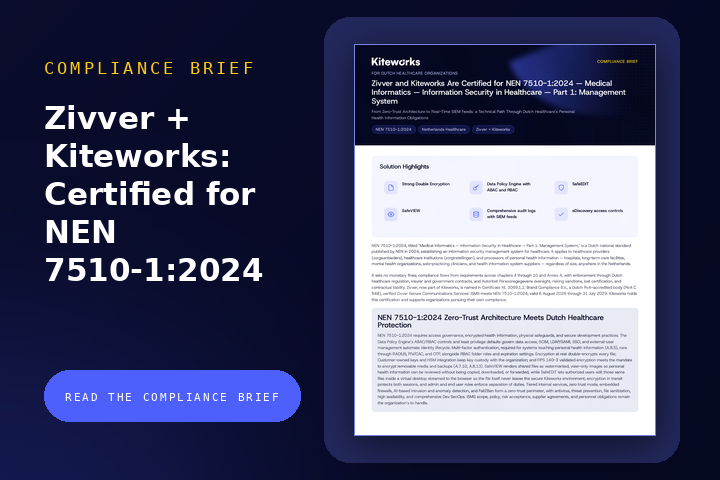
Kiteworks already holds this certification: Zivver, now part of Kiteworks, appears on Certificate NL 3069.1.1, issued by RvA-accredited Brand Compliance B.V. and verified on NEN’s official certification page, confirming its ISMS meets the standard. The platform combines double encryption, zero-trust architecture, and a Data Policy Engine enforcing role-based and attribute-based access, giving organizations a certified path to compliance.

Governing Access and Encrypting Health Data Across Every Endpoint
Healthcare organizations must govern who touches personal health information at every access point, from clinician logins to remote sessions. This standard requires multi-factor authentication for any system touching health data, encrypted removable media and backups, and enforced separation of duties. Without centralized identity lifecycle management and encryption key custody, organizations struggle to maintain least-privilege access while supporting SSO, external users, and zero-trust network segmentation.
Proving Continual ISMS Improvement Without Fragmented Evidence
Demonstrating continual improvement under this standard requires measurable security objectives, periodic risk assessments, ongoing control monitoring, and oversight of supplier changes, all backed by documented evidence.
Cloud governance rules under A.5.23 also require organizations to track exactly where health data resides and who can access it.
Assembling this evidence from disconnected systems and enforcing accountability across compliance teams and suppliers strains most organizations’ existing tools.


Detecting, Responding, Proving Incidents Under Deadline Pressure
Meeting this standard’s incident response mandate means detecting security events, responding through documented procedures, preserving legally defensible evidence, and tracking vulnerabilities and capacity, all while synchronizing clocks and analyzing log files under A.8.15. Coordinating these tasks across disconnected monitoring tools, verifying that evidence remains admissible, and giving staff a reliable reporting channel challenges teams without a unified security operations platform.
Zero-Trust Access Governance with Customer-Owned Encryption Keys
Kiteworks’ Data Policy Engine enforces ABAC and RBAC controls with least privilege defaults, while SCIM, LDAP/SAML SSO, and external-user management automate identity lifecycle.
Multi-factor authentication runs through RADIUS, PIV/CAC, and OTP.
Double encryption at rest, customer-owned keys, and HSM integration keep key custody with the organization, meeting the mandate to encrypt removable media and backups.
SafeVIEW, SafeEDIT, and a zero-trust perimeter with embedded firewalls and AI-based intrusion detection separate admin and end-user roles.


Consolidated Compliance Reporting and Data Sovereignty Controls
Kiteworks’ Data Policy Engine operationalizes access governance through ABAC and RBAC controls, while compliance reports covering audit log, insider and outsider threats, GDPR, and HIPAA supply measurable evidence of control performance. Comprehensive audit logs with SIEM feeds normalize activity into a single stream, and admin role-based access assigns a dedicated compliance role that separates duties. Data sovereignty and geofencing store and route data within a user’s assigned country, while customer-owned keys and single-tenant private cloud preserve key custody.
Real-Time SIEM Feeds and Legal-Hold Evidence Preservation
Comprehensive audit logs with SIEM feeds aggregate every security event into a single, unthrottled stream, fed in real time to ArcSight, QRadar, Splunk, and LogRhythm. AI-based intrusion and anomaly detection identify suspicious activity before it becomes a breach. Legal hold and eDiscovery access controls, limited to Data Leak Investigator Admins, preserve evidence under A.5.28. Secure Data Forms give staff a reporting channel, and NTP clock-sync checks with SNMP Health Monitoring track timestamps, capacity, and vulnerabilities.

Frequently Asked Questions
Healthcare organizations must enforce multi-factor authentication for any system touching health data, encrypt removable media and backups, maintain separation of duties, and implement centralized identity lifecycle management with encryption key custody to support least-privilege access, SSO, and zero-trust segmentation.
They must establish measurable security objectives, conduct periodic risk assessments, monitor controls continuously, oversee supplier changes, and maintain documented evidence, including tracking exact health data locations and access under cloud governance rules such as A.5.23.
Teams must detect events, follow documented response procedures, preserve legally defensible evidence, track vulnerabilities and capacity, synchronize clocks, and analyze logs under A.8.15, all while coordinating across disconnected tools without a unified security operations platform.
Kiteworks uses its Data Policy Engine for ABAC and RBAC controls with least-privilege defaults, automates identity lifecycle via SCIM/LDAP/SAML SSO, supports MFA through RADIUS/PIV/CAC/OTP, provides double encryption at rest with customer-owned keys and HSM integration, and enforces role separation via SafeVIEW, SafeEDIT, and a zero-trust perimeter with AI-based intrusion detection.
Featured Resources
Zivver and Kiteworks Are Certified for NEN 7510-1:2024
Zivver and Kiteworks Are Certified for NEN 7510-1:2024
HIPAA Compliance in 2025: Navigating Enhanced Security Requirements and Rising Enforcement